
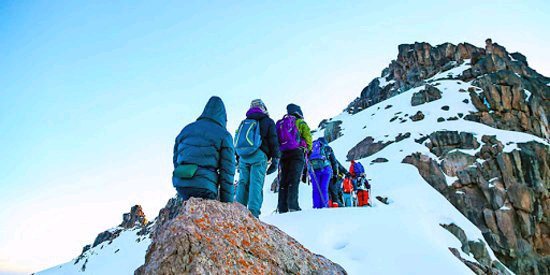
How many of you are familiar with the nations that have the coldest climate in Africa? Because of the widespread perception that Africa experiences an abnormally high average temperature, travelers commonly ask whether or not the climate in Africa ever experiences colder temperatures. The answer is that it is dependent on how the questioner defines “cold,” but it is true that there are regions of Africa where it does get really cold on a daily basis. The answer to this question depends on how the questioner defines “cold.”
An illustration of such a location in Africa is the country of Lesotho, which is predominately made up of mountains, has exceptionally low temperatures throughout the winter, and receives a great amount of snowfall. At least by the standards of the locals, the temperature is pretty brisk in the city of Centurion, which is located in South Africa exactly in the middle of Pretoria and Johannesburg.
Temperatures in Africa are typically quite high because of the continent’s position in the intertropical zone, which is between the tropics of Capricorn and Cancer. Even if the country as a whole does not experience cold weather, there are still some areas where a specific region or mountain may experience extremely cold temperatures and even snow on occasion.
5. MOUNT KENYA-KIRINYAGA (KENYA)
This mountain in Kenya has temperatures that range from ten to twenty degrees Celsius, and its landmass can be anywhere from seven hundred fifty to two hundred seventy-six square kilometers in size. The peak of the mountain reaches a height of five thousand 179 meters, which is equivalent to seventeen thousand fifty-seven feet (5,199 M-17,057ft).
The shortest distance between two points is 4,850 meters (15,260 feet), which is the lowest point (15,250ft). Because of the mountain’s elevation, Mount Kenya is yet another location in Africa that receives snowfall throughout the winter months. Visitors are not deterred from coming here because it is open to everyone and there are no barriers to entry. Snow and rain are typical from March through December, however there is almost no wind throughout this time.
4. MOUNT KILIMANJARO (TANZANIA) (TANZANIA)
This mountain has a landmass of 388,500 hectares, a temperature range of 29 degrees Celsius to 27 degrees Celsius (84.2 degrees Fahrenheit to 80.6 degrees Fahrenheit), a highest point that is 5,899 meters (5,899 m), and a lowest point that is 4,05 meters (4,5 m) (4,005 m).
As a consequence of this, Mount Kilimanjaro is subjected to both equatorial trade winds and high altitude trade winds, both of which enable it to have a more temperate climate than the majority of Africa. At its highest point, the temperature can drop to as low as -15 to -29 degrees Celsius (5 to -17 degrees Fahrenheit). In addition, the temperature can reach as high as 21 or 27 degrees Celsius, and it is possible for it to snow in this part of the world when the temperature reaches those levels.
3. SOUTH AFRICA
The temperature in South Africa can range anywhere from 16 to 40 degrees Celsius. The landmass has a total area of 1,221,037 kilometers squared (471,445 square meters). At its lowest point, the elevation is 0 meters above sea level, while the highest point measures 3,450 meters (4,450m) above sea level. There is a wide range of humidity, coldness, and snowfall that can be experienced in South Africa.
Temperatures across the country can fall to as low as 16 degrees Celsius during the coldest months of the year. The latitude of the nation in the southern hemisphere, between 22 and 35 degrees south of the equator, is the primary factor in determining that nation’s climate.
2. MOROCCO
The size of Morocco’s landmass is 7,108,000 km2, and the country’s average temperatures range from 8 to 40 degrees Celsius (710,850kmsq). The distance between the lowest and highest points is fifty-five meters and four thousand, one hundred and sixty-five meters, respectively (4,165m).
Morocco is the country that is situated the closest to Europe. The climate of the country can be broken down into a number of distinct zones, including alpine, semi-arid, Mediterranean, sub-Mediterranean, and continental. The many regions of Morocco each have their own unique climate, which can be characterized by a wide range of temperatures.
The season in which one studies Morocco’s climate is the primary factor that shapes that climate. The summertime is typically when the temperature is at its highest.
1. LESOTHO
Lesotho experiences temperatures from 18 to 28 degrees Celsius. The surface area of the landmass is thirty three hundred fifty-five square meters (30,355sqm), and its highest point is three thousand four hundred eighty two meters (3,482m), while its lowest point is one thousand four hundred meters (1,400m) (1,400m).
Lesotho is a small country located in close proximity to South Africa. It is a country that has been estimated to have a total territory of 30,355 square kilometers as well as a population of approximately 2.1 million people.